Energy-Efficient Comfort Powered by the Earth Beneath Your Home
Birmingham summers push conventional HVAC systems hard, and your energy bills show it. Geothermal systems tap into the earth’s stable underground temperature to heat and cool your home with more efficiency. Aire Serv of Birmingham designs, installs, and services geothermal systems that help keep you comfortable while cutting energy costs significantly.
Energy-Efficient Comfort Powered by the Earth Beneath Your Home
Schedule Online
Thank you for requesting a call!
We'll give you a call shortly to confirm your details and schedule service.
We're Sorry
Due to a system error, we did not get your request. Please call your local Aire Serv for immediate assistance.
We're Sorry
This area is not currently serviced by Aire Serv.
Yes! You can email me service reminders and other messages.
Aire Serv, a Neighbourly company, on its own behalf and on behalf of its affiliates and franchisees requests your consent to send promotional and other electronic messages to you concerning products and services they believe are of interest to you. By checking this box, you agree to receive these messages. You can unsubscribe at any time.
Text opt-in does not apply for Canadian residents.
How Geothermal Heating & Cooling Works and Why It Makes Sense
Geothermal systems use the earth’s consistent underground temperature as a renewable energy source to heat and cool your home. Here is a closer look at the three components that make it work.
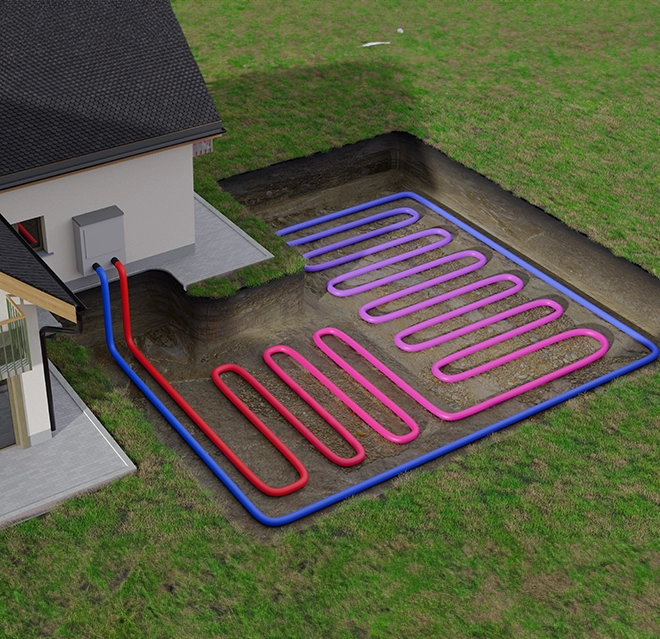
A few feet below the surface, the ground maintains a consistent temperature year-round, somewhere in the 60–68-degree range in central Alabama. That stability is what a geothermal system is built to use. A series of pipes, called a ground loop, is buried in your yard and filled with a water-based fluid. That fluid circulates continuously, exchanging heat between your home and the earth.
In summer, the system pulls heat out of your home and puts it into the cooler ground. In winter, it does the exact opposite, drawing warmth up from the earth and moving it into your home. Since the ground temperature stays steady no matter what the air outside is doing, the system operates efficiently regardless of the season.
Ground loops come in several configurations. Horizontal loops are laid out in wide trenches and work well for larger lots. Vertical loops are drilled straight down and are better for smaller properties. Ponds or lakes are an option if your property has access to standing water. Our team will evaluate your property during a consultation and recommend the best configuration that makes the most practical and financial sense for your situation.
Once a loop is installed, it can last up to 50 years or more. There are no exposed parts, no weather damage to worry about, and virtually no maintenance involved after installation. It is one of the most durable components in any home comfort system.
The indoor heat pump sits inside your home, similar in size and placement to a conventional air handler, and connects directly to your existing ductwork. It takes energy gathered by the ground loop and converts it into conditioned air. No combustion, no outdoor condenser, no fuel lines.
Since geothermal heat pumps do not burn anything to create heat, they are safer and cleaner than gas furnaces. They also have fewer exposed moving parts, which means a longer lifespan and fewer repair calls. The indoor unit typically lasts 20 to 25 years, which is about twice as long as a standard air conditioning system.
Efficiency for these systems is measured by COP (coefficient of performance). A COP of 4 means the system produces four units of heating or cooling energy for every one unit of electricity consumed. Most geothermal systems run at a COP of 3 to 5, which is 300-500% efficiency. That is a number no gas furnace or conventional heat pump can come close to matching.
The upfront cost of a geothermal system is higher than that of a conventional HVAC unit. What changes the picture is the 30% federal tax credit available under the Inflation Reduction Act, which applies to the full installation cost, including labor. For a $20,000 system, that a $6,000 credit.
Alabama Power also offers rebates for qualifying geothermal installations, further reducing out-of-pocket costs. Once the system is running, most homeowners see energy bill reductions of 30-70% compared to their previous bills. Over a 7- to 10-year span, the numbers clearly favor geothermal.
We prepare a personalized cost-benefit estimate for each customer before any work is scheduled. You will know what the investment looks like, what incentives you qualify for, and what your expected payback timeline is, before you even commit to anything.
What the Geothermal Installation Process Looks Like
Installing a geothermal system is a more involved process than replacing a furnace or air conditioner; it requires site preparation, groundwork, and careful coordination. With the right team managing it, the process moves smoothly and with minimal disruption to your daily life. Here is how we approach it from start to finish:
Property Assessment – We evaluate your lot size, soil conditions, and existing HVAC setup to determine the right loop type and system capacity for your home.
System Design & Load Calculation – We size the system to match your home’s actual heating and cooling load. A properly sized geothermal system performs better and costs less to operate than one that is over- or underspecified.
Permitting & Contractor Coordination – Ground loop installation requires permits and often involves specialized drilling or excavation crews. We manage that process so you’re working with one point of contact, not multiple vendors.
Ground Loop Installation – Horizontal loops typically take one to two days; vertical borehole drilling can take longer. Our team works efficiently and restores your yard as close to its original condition as possible.
Indoor Unit Installation – Our licensed HVAC team installs the heat pump unit, connects it to your ductwork, and runs all the necessary refrigerant and electrical lines.
System Commissioning & Testing – We run the full system under load, verify COP readings, confirm thermostat programming, and walk you through how everything works before we consider the job complete.
Most residential installations are completed in three to five days. We will give you a clear timeline at the start and stick to it.
What the Geothermal Installation Process Looks Like
The Aire Serv Advantage
From tune-ups and maintenance to heater repair and air conditioning replacement, we provide services that keep the air you breathe clean and keep your home or business at the perfect temperature.
Geothermal is one of the most effective home comfort systems, but it also raises a lot of questions before homeowners decide to move forward. Here are honest answers to the ones we hear most often in Birmingham.
Residential geothermal systems in Birmingham typically run between $15,000 and $30,000 installed, depending on the home’s size, loop type, and site conditions. That is a larger upfront investment than conventional HVAC, but the 30% federal tax credit, available utility rebates, and significantly lower monthly utility bills change the long-term math. Most homeowners reach payback within 7 to 10 years. Contact us today for a site-specific estimate with no obligation.
The ground loops are made to last 50 years or more with virtually no maintenance. The indoor heat pump unit typically lasts 20 to 25 years, roughly twice the lifespan of a conventional air conditioner or heat pump. When you factor in fewer repairs, no outdoor unit replacement cycles, and lower operating costs over time, geothermal tends to be the more economical choice. Contact our team today to discuss whether it is the right investment for your home.
Not necessarily. Horizontal ground loops need more yard space and work well for larger lots. Vertical loops, where boreholes are drilled straight down, require much less surface area and are a practical option for smaller properties. If you have a pond or a lake on your property, a water-source loop may also be an option. The right choice depends on your specific area. Schedule an assessment, and we will evaluate your property and recommend the best configuration for you.
In most cases, yes. Geothermal heat pumps connect to standard forced-air duct systems the same way a conventional unit does. If your existing ductwork is in decent shape, it typically won’t need replacement or modification. If we find issues during the assessment, leaks, undersized runes, or inadequate installation, we will flag them upfront so there are no surprises. Geothermal can also be paired with a ductless mini-split system in homes where ducted distribution doesn’t make sense. Call us today to schedule a walkthrough.
A lot less than what most homeowners are used to. There is no outdoor condenser unit kicking on and off, so that familiar cycling noise disappears. The indoor heat pump unit runs quietly; most people describe it as similar to a refrigerator hum. If your current system is loud or disruptive, switching to a geothermal system is a noticeable improvement. Contact Aire Serv of Birmingham today to learn more or schedule an appointment.
The ground loop needs virtually no attention once installed. The indoor unit should be serviced once a year for filter replacement, coil cleaning, refrigerant level check, and general diagnostics, like any HVAC system. Since there are no outdoor units in the weather conditions, many of the wear points that are common in conventional systems do not apply. We offer the Aire Serv Advantage Plan™ to help keep your system running at peak performance year-round.
Worry-Free HVAC Starts with Our Advantage Plan
Keep your system running smoothly with expert care you can count on.