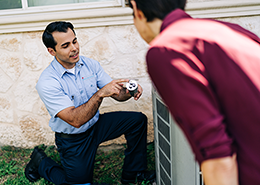
Everything below is a recorded step in the workflow our professionals run on a tablet at your home—not simply a line item on an invoice.
Corrosion monitoring photo. The same coil face is photographed the same way at every visit. Your first photo establishes a baseline; future photos show year-over-year corrosion and whether protection is working.
Salt-Away coil flush. Applied to coil faces and the base pan, then rinsed thoroughly while fins are combed and vegetation is cleared from around the unit. Before-and-after photos document the work.
Dielectric grease and Boeshield T-9. Electrical connections are tightened dry, then protected with dielectric grease where appropriate. Boeshield T-9 is applied to valve caps, line fittings, and the fan motor housing. Treated hardware is photographed with the panel open and power off.
DiversiTech Coil Guard. Applied annually in spring only when the system is healthy, the coil is clean and completely dry, and no coating has already been applied that year. If conditions aren't right, we hold off.
Ceramic cabinet protection. Painted panels are treated and buffed, with Boeshield T-9 applied to fasteners and seams—never the fins. Before-and-after photos document the work.
One-time restoration cleaning. If your coil has chalky white oxidation at enrollment, the first visit includes Nu-Calgon Nu-Brite alkaline foam, controlled dwell time, fin combing, debris removal, and a low-pressure rinse. If fragile fins begin flaking, we stop and document the condition.
No acid brighteners. We never use acid brighteners on coils. They can attack the aluminum they're meant to protect.
How Coatings Are Actually Rated
Coil coatings are not all the same and there is a real specification behind the good ones.
The reference test is ASTM B117, which exposes coated aluminum coupons to continuous salt fog and measures how long they resist corrosion. Serious HVAC coil coating products publish performance against it, with widely specified product lines rated to no less than 5,000 hours on aluminum coupons.
Two honest caveats, because this is where the industry oversells.
Salt spray hours are a comparison tool, not a lifespan prediction. Coating industry sources are explicit that longer ASTM B117 exposure does not automatically translate into longer service life, since continuous fog does not replicate the wet, dry, and UV cycling equipment actually experiences. Use the ratings to compare products, not to predict how long your coil lasts.
Coating costs a little efficiency up front. A coated coil transfers heat marginally less well than a bare one, and manufacturers acknowledge slightly lower efficiency ratings on treated coils. You are trading a small fixed penalty at day one against avoiding a large compounding penalty as an uncoated coil corrodes. In direct salt exposure that trade is clearly worth making. Two miles inland it may not be, which is why we do not apply coastal treatment to inland equipment.
Coastal engineering practice generally holds that condenser coils within a few miles of open salt water should carry an ASTM B117 salt spray rating, and that properties within about a mile should have both outdoor and indoor coils rated. That is a useful benchmark when specifying a replacement here rather than accepting the standard configuration.
Storm Season Protection
Anchoring. Florida requires outdoor equipment to be anchored, and coastal wind zones carry the strictest requirements. Anchoring hardware corrodes in the same environment as everything else, so verifying it is intact is part of coastal maintenance rather than a one-time installation check.
Surge protection. Coastal areas lose power early in a storm and regain it late, and restoration surges are hard on control boards, capacitors, and inverter-driven equipment. Equipment-level surge protection is worth considerably more here than in most of the territory, and it is far cheaper than a control board.
Elevation. Much of the coastal territory sits in AE or VE flood zones. A condenser submerged in saltwater is generally not salvageable even if it runs afterward, because water intrusion into the compressor and controls produces failures that surface weeks later.
Post-storm inspection. The item most owners skip and most regret. A system that took saltwater intrusion can run normally for weeks and then fail, at which point connecting it to the storm for an insurance claim is much harder. Documentation is easier to obtain before you need it.
If your outdoor unit was submerged, do not run it. Leave it off and call us.
The Coastal Advantage Plan
$349 per year or $34.99 per month. A full upgraded membership tier, not an add-on.
Everything in the standard Advantage Plan:
- Two visits per year, spring and fall, running the 22-step documented workflow
- Before and after photographs at matched angles
- A written findings report after every visit
- Priority scheduling
- 15 percent off repairs and diagnostic labor
- Equipment registry with dataplates and filter sizes on file
Plus eight coastal steps, taking a full enrollment visit to 33:
- Corrosion monitoring photo of the same coil face every visit, tracked year over year
- Salt-Away coil flush with matched before and after photos
- Dielectric grease and Boeshield T-9 on electrical connections and exposed hardware, with a treated-hardware photo
- DiversiTech Coil Guard protective coating applied annually on spring visits, gated on a clean, dry, fault-free system
- Ceramic cabinet protection with before and after photos
- One-time Nu-Brite restoration cleaning on your first visit when oxide buildup is present
Paying annually costs $70.88 less than twelve monthly payments.
Before we leave, the technician shows you the flush before and after difference if you are home. That is the whole argument for the tier, and you should see it rather than read about it.
Who Needs the Coastal Tier
We would rather put you on the right tier than the more expensive one.
Clear yes: Pensacola Beach, Perdido Key including the island and River Road corridor, the entire Gulf Breeze peninsula including Tiger Point, Oriole Beach, Woodlawn Beach, and Midway, Navarre Beach, and Sound-side Navarre.
Usually yes: Pensacola waterfront neighborhoods along Scenic Highway, Bayou Texar, and Bayou Chico, and waterfront property anywhere on the bay or the Sound.
Judgment call: roughly one to two miles from salt water. The answer depends on wind exposure and, more usefully, on what your outdoor unit already looks like. Visible fin corrosion at five to eight years means the exposure is real regardless of what a map says.
Clear no: Beulah, Pace, Milton, Cantonment, mainland Navarre subdivisions, and inland Pensacola. The standard Advantage Plan is the right tier and the coastal program would do nothing for you.
Related Services
Written by the team at Aire Serv of Northwest Florida.
Technically reviewed by Justin B., NATE-certified and EPA 608 certified, 19 years in the trade.
Reviewed for accuracy by owner Justin Sonntag, a 26-year Gulf Coast resident.
Florida Certified Air Conditioning Contractor, license CAC1823566.
Last reviewed: August 2026
Questions about your system? Call or book online in about a minute.


.webp)