Skip to Main Content Skip to Footer Content

HVAC UV Lamps in Northwest Florida

UV in HVAC has a practical use in Northwest Florida: treating the evaporator coil and drain pan, where moisture remains during the long cooling season. UV can help limit biological buildup, musty odors, and reduced heat transfer on these surfaces.

Air moving through a duct passes a UV lamp too quickly for the same effect. We install UV for coil applications and explain exactly what it is designed to do.

Aire Serv of Northwest Florida, locally owned, licensed CAC1823566.

Call or schedule online.

HVAC UV Lamps in Northwest Florida
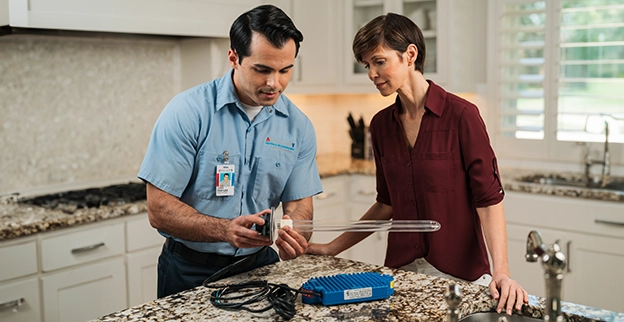
An asv technician explaining repairs to the client.

Schedule Online

By checking this box, I agree to opt in to receive automated SMS and/or MMS messages from Aire Serv, a Neighborly company, and its franchisees to the provided mobile number(s). Messages & data rates may apply. Message frequency varies. View Terms and Privacy Policy. Reply STOP to opt out of future messages. Reply HELP for help.

By entering your email address, you agree to receive emails about services, updates or promotions, and you agree to the Terms and Privacy Policy. You may unsubscribe at any time.

  • UV in HVAC has one application with solid reasoning behind it and one that is oversold. The difference is worth understanding before you buy either.

    Your evaporator coil is wet whenever the system is cooling, which in Northwest Florida is most of the year. Condensate collects in the drain pan below it. The plenum is dark, warm at the edges, and never dries out during the season.

    Biological film forming on those surfaces produces three things: musty odor circulating through the house whenever the system starts, reduced heat transfer across a coil that now has a layer on it, and material sloughing off into the pan that contributes to drain blockages.

    A UV-C lamp positioned at the coil provides continuous exposure to a fixed surface, which limits that growth. Long contact time on a stationary target is the condition the technology actually needs, and a coil provides it.

    That makes it a maintenance tool rather than an air treatment, and on that basis it earns its place in a humid climate.

    It makes the most sense for homes with recurring musty odor traced to the coil or pan, homes where the coil has fouled biologically before, allergy and asthma households after moisture and filtration have been addressed, and properties that sit closed for part of the year.

  • We would rather set this out plainly than let you discover it after purchase.

    It does not remove particles. No UV lamp filters anything. Pollen, dust, and dander pass by unaffected. That is what filtration is for.

    It does not remove moisture. If your house feels damp, UV changes nothing about that.

    It does not clean ducts. A coil lamp treats the coil. It does not reach into your duct runs.

    It does not sterilize air in motion at residential duct velocities. Air moves past the lamp quickly and contact time is very short, which makes claims about in-duct air sterilization far weaker than the marketing suggests. If someone is selling you UV as air purification rather than coil maintenance, ask them about contact time.

    It does not fix a moisture source. If a duct leak, a wet crawl space, or a bathroom fan venting into an attic is driving humidity, UV treats a symptom while the cause continues.

    And it does not replace maintenance. A lamp does not clean a coil that is already fouled. Cleaning comes first, then the lamp keeps it from recurring.

    None of that makes UV useless. It makes it a tool with a defined job rather than a solution to indoor air quality generally. Used for coil and drain pan treatment in a humid climate, it does something real and measurable over time. Sold as whole-home air purification, it is being oversold, and the gap between those two framings is where homeowners get taken.

    If a quote describes UV as purifying your air rather than treating your coil, that difference is worth pressing on.

An asv technician standing beside a van with a toolkit.

The Ozone Question, Which Matters Most

This is the most important thing on this page.

UV-C at 254 nanometers does not generate ozone. That is the germicidal wavelength used for coil treatment, and it is what we install.

UVV at 185 nanometers does generate ozone, by design. It is sometimes offered as an option on the same equipment, marketed for odor and volatile organic compound control, and the ozone production is the working mechanism rather than a side effect.

Ozone is a respiratory irritant. Some devices are marketed on the smell of ozone as evidence they are working, which is exactly backward.

If you are being quoted a UV system, ask directly whether the lamp is UV-C only or whether it includes a UVV component, and ask whether it produces ozone. A vague answer is an answer.

We specify UV-C for coil treatment. Where a product line offers a UVV option, we do not select it.

One more thing worth knowing: bulbs are consumable, and they fail invisibly. A UV-C bulb continues emitting visible light well after its germicidal output has dropped below useful levels, so a lamp that looks like it is working may not be. Manufacturer intervals are typically annual.

Placement deserves the same scrutiny. A lamp must have a direct line of sight to the coil surface and the drain pan area it is meant to treat, and one installed where the coil is shadowed does very little. It also has to account for what else it illuminates, since prolonged UV degrades some plastics, wiring insulation, and drain pan materials. This is not a component to mount wherever there happens to be room.

Why the Coil Application Makes Sense Here

Your evaporator coil is wet whenever the system is cooling, which in Northwest Florida is most of the year. Condensate collects in the drain pan below it. The plenum is dark, warm at the edges, and never dries out during the season.

Biological film forming on those surfaces produces three things: musty odor circulating through the house whenever the system starts, reduced heat transfer across a coil that now has a layer on it, and a contribution to drain line blockages as material sloughs off into the pan.

A UV-C lamp positioned at the coil provides continuous exposure to a fixed surface, which limits that growth. It is a maintenance tool rather than an air treatment, and on that basis it earns its place in a humid climate.

Who it makes the most sense for: homes with recurring musty odor traced to the coil or pan, homes where the coil has fouled biologically before, allergy and asthma households after moisture and filtration have been addressed, and properties that sit closed for part of the year.

What UV Does Not Do

We would rather set this out plainly than let you discover it after purchase.

It does not remove particles. No UV lamp filters anything. Pollen, dust, and dander pass by unaffected. That is what filtration is for.

It does not remove moisture. If your house feels damp, UV changes nothing about that. See whole-home dehumidification.

It does not clean ducts. A coil lamp treats the coil. It does not reach into your duct runs. See duct cleaning.

It does not sterilize air in motion at residential duct velocities. Contact time is too short for the claims commonly made.

It does not fix a moisture source. If a duct leak, a wet crawl space, or a bathroom fan venting into an attic is driving humidity, UV treats a symptom while the cause continues.

It does not replace maintenance. A lamp does not clean a coil that is already fouled. Cleaning comes first, then the lamp keeps it from recurring.

The Ozone Question, and Why It Matters

This is the most important thing on the page.

UV-C at 254 nanometers does not generate ozone. That is the germicidal wavelength used for coil treatment, and it is what we install.

UVV at 185 nanometers does generate ozone, by design. It is sometimes offered as an option on the same equipment, marketed for odor and volatile organic compound control, and the ozone production is the mechanism rather than a side effect.

Ozone is a respiratory irritant. Some devices are marketed on the smell of ozone as evidence they are working, which is exactly backward.

If you are being quoted a UV system, ask directly whether the lamp is UV-C only or whether it includes a UVV component. Ask whether it produces ozone. A vague answer is an answer.

We specify UV-C for coil treatment. Where a product line offers a UVV option, we do not select it.

Installation and Bulb Replacement

Placement determines whether it works. A lamp has to have direct line of sight to the coil surface and the drain pan area it is meant to treat. A lamp installed where the coil is shadowed does very little. This is not a component you mount wherever there is room.

Electrical and access. The lamp needs power, and it needs to be reachable for bulb changes without disassembling the air handler.

Safety. UV-C is harmful to eyes and skin on direct exposure. Systems include interlocks and viewports for a reason, and the lamp should never be operated with the access panel open.

Material exposure. Prolonged UV degrades some plastics and flexible materials. Placement has to account for what the lamp is pointed at besides the coil, including wiring insulation and drain pan material.

Bulbs are consumable, and they fail invisibly. A UV-C bulb continues to emit visible light well after its germicidal output has fallen below useful levels. It looks like it is working when it is not. Manufacturer intervals are typically annual, and a lamp that has not been changed on schedule is a lamp doing nothing.

Bulb replacement is included in maintenance visits for Advantage Plan and Coastal Advantage Plan members with UV installed, which is the practical reason members get value from it and non-members frequently do not.

The Order That Actually Works

UV is step four, not step one.

  1. Control humidity. Most indoor air quality complaints in this climate are moisture complaints. See dehumidification.
  2. Fix the source. Duct leakage, crawl space moisture, bathroom fans venting into attics, standing water in a drain pan. See duct sealing.
  3. Clean what is already there and filter what arrives. A coil that is already fouled needs cleaning, not a lamp.
  4. Then add UV to keep the cleaned coil and pan from returning to where they were.

Installing UV first means paying to slow the regrowth of a problem you have not fixed.

Related Services

Written by the team at Aire Serv of Northwest Florida.
Technically reviewed by Justin B., NATE-certified and EPA 608 certified, 19 years in the trade.
Reviewed for accuracy by owner Justin Sonntag, a 26-year Gulf Coast resident.
Florida Certified Air Conditioning Contractor, license CAC1823566.

Last reviewed: September 2026

Questions about your system? Call or book online in about a minute.
The Aire Serv Advantage

From tune-ups and maintenance to heater repair and air conditioning replacement, we provide services that keep the air you breathe clean and keep your home or business at the perfect temperature.

Worry-Free HVAC Starts with Our Advantage Plan

Keep your system running smoothly with expert care you can count on.

UV Light Questions

  • For the coil application, yes, with a real basis. A UV-C lamp aimed at the evaporator coil and drain pan provides continuous exposure to surfaces that stay wet through most of the year here, limiting the biological film that produces musty odor and reducing heat transfer. For air sterilization inside a duct, the claims are much weaker, because air moves past the lamp quickly and contact time is short. If someone is selling you UV as air purification rather than coil maintenance, ask them about contact time at your system's airflow.

Worry-Free HVAC Starts with Our Advantage Plan

Keep your system running smoothly with expert care you can count on.

Schedule Online

By checking this box, I agree to opt in to receive automated SMS and/or MMS messages from Aire Serv, a Neighborly company, and its franchisees to the provided mobile number(s). Messages & data rates may apply. Message frequency varies. View Terms and Privacy Policy. Reply STOP to opt out of future messages. Reply HELP for help.

By entering your email address, you agree to receive emails about services, updates or promotions, and you agree to the Terms and Privacy Policy. You may unsubscribe at any time.