Configuration Is the Job
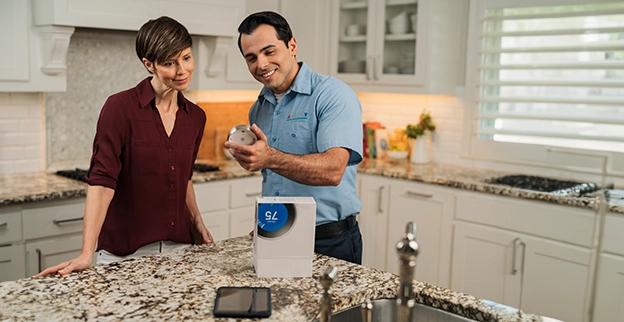
Anyone can mount a thermostat. Setting it up for your equipment and this climate is the work - and it is often skipped during DIY or rushed installations.
Reversing valve (O vs. B): A wrong setting can make a heat pump heat when it should cool, or vice versa. It becomes obvious during a genuine cold snap, which is exactly what happened to a number of homes here during the January 2025 freeze. This is a configuration setting, not a repair, and it takes seconds to check and years to notice.
Auxiliary heat lockout: Factory defaults may not suit Northwest Florida. Set too high, backup heat can drive up electric bills; set too low, it may not engage when needed. See the furnace installation page for how this is specified alongside backup heat sizing.
Staging: Two-stage and variable-capacity systems need compatible, properly configured thermostats. Otherwise, you may lose efficiency and dehumidification benefits.
Cycle rate and differential: These settings affect temperature swings and short cycling. They should be matched to the equipment.
Fan configuration: Incorrect settings can keep the fan running and re-evaporate moisture from the coil, increasing indoor humidity.
Sensor calibration and placement: A thermostat on a wall that gets afternoon sun, near a supply register, or on an exterior wall reads a temperature the rest of the house is not experiencing.
When we install a thermostat, configuration is part of the job. We explain what was set and why.
The C-Wire Question
The most common obstacle to a smart thermostat in an older home.
Smart thermostats need continuous power. Older wiring frequently has no common wire, since traditional thermostats ran on the heating and cooling call wires alone. Without a C-wire, a smart thermostat will either not work or will work intermittently in ways that look like equipment faults.
Options, in order of preference:
Run a new wire. Cleanest, most reliable, and often practical when the run is accessible.
Repurpose an existing conductor. Many older cables have an unused wire in the bundle that can be landed as a common.
Add-a-wire adapter at the air handler. A manufacturer-supplied module that lets an existing conductor carry two signals. Works well when installed correctly, and it is a common source of odd behavior when it is not.
Power-stealing operation. Some thermostats can run without a C-wire by drawing small current through the control circuit. It works until it does not, and the failures look like random shutdowns or a thermostat that reboots. We avoid it where a real solution is available.
We check what you have before recommending equipment, so you do not buy a thermostat your wiring cannot support.
When It Is Actually the Thermostat
Sometimes the thermostat is the failure rather than the configuration.
Dead display. Batteries in a battery-powered unit, a tripped float safety switch cutting power in the control circuit, a blown low-voltage fuse at the air handler, or a failed transformer. A blank thermostat with the system also dead is frequently the float switch doing its job on a blocked condensate drain.
Inaccurate reading. A drifted or failed temperature sensor, or a thermostat placed somewhere that does not represent the house.
Unresponsive to calls. Failed internal relays or a wiring fault at the terminal block.
Short cycling. Sometimes a differential setting, sometimes a failing thermostat, sometimes an oversized system that no thermostat setting will fix.
Erratic behavior on smart models. Frequently the power supply issue described above rather than a defective thermostat.
Humidity sensor failure. On models with humidity control, a failed sensor produces strange behavior including extended cooling cycles that overcool the house.
We diagnose before replacing, because swapping a thermostat that was never the problem leaves you with a new thermostat and the same complaint.
Rentals, Seasonal Properties, and Second Homes
Different requirements from an owner-occupied house.
Remote humidity monitoring with alerts matters more than any convenience feature. A closed property in this climate can develop a moisture problem quietly, and finding out from a phone alert rather than from a guest is the entire value proposition.
Setpoint limits prevent a guest from setting the thermostat to 65 and freezing the coil, or turning the system off entirely in August.
Access control so a property manager can adjust remotely without a physical visit.
Simplicity for occupants. A complicated interface in a vacation rental generates support calls.
For coastal seasonal properties, pairing this with dedicated dehumidification helps protect the property during the closed months.
Zoning
A zoning system divides the house into separately controlled areas, each with its own thermostat and motorized dampers. It is a real solution to a real problem, and it should not be the first thing anyone quotes you.
Zoning works well when the duct system can support it, and the equipment can modulate capacity. It works poorly when bolted onto a single-stage system with marginal ductwork, because closing dampers on equipment that only knows full output raises static pressure and creates noise, airflow issues, and equipment problems.
Before recommending zoning, we check whether adding return air, adding transfer grilles, or rebalancing the existing system solves the problem for a fraction of the cost. Frequently, it does. See duct repair and replacement.
Related Services
Written by the team at Aire Serv of Northwest Florida.
Technically reviewed by Justin B., NATE-certified and EPA 608 certified, 19 years in the trade.
Reviewed for accuracy by owner Justin Sonntag, a 26-year Gulf Coast resident.
Florida Certified Air Conditioning Contractor, license CAC1823566.
Last reviewed: August 2026
Questions about your system? Call or book online in about a minute.