Skip to Main Content Skip to Footer Content

Air Duct Sealing in Pensacola, FL

If your ducts run through an attic, as they do in most Northwest Florida homes, every gap loses conditioned air and pulls hot, humid, dusty attic air into your home. That can mean rooms that never cool, damp indoor air, and recurring dust. ENERGY STAR estimates 20–30% of duct air can be lost through leaks.

We measure, seal, and measure again so you can see the difference.

Aire Serv of Northwest Florida, locally owned, licensed CAC1823566.

Call or schedule online.

Air Duct Sealing in Pensacola, FL
Aire Serv technician standing in front of an Aire Serv van.

Schedule Online

By checking this box, I agree to opt in to receive automated SMS and/or MMS messages from Aire Serv, a Neighborly company, and its franchisees to the provided mobile number(s). Messages & data rates may apply. Message frequency varies. View Terms and Privacy Policy. Reply STOP to opt out of future messages. Reply HELP for help.

By entering your email address, you agree to receive emails about services, updates or promotions, and you agree to the Terms and Privacy Policy. You may unsubscribe at any time.

  • Everyone understands that a leaky duct wastes air. What gets missed is where the replacement air comes from.

    Your system moves a fixed volume. When some of it escapes into the attic, the system makes up that volume by drawing air from wherever it can find it, which in most Northwest Florida homes means the attic itself. So you are not only losing cool dry air. You are importing hot, saturated, dusty air and delivering it into your living room.

    That is why duct leakage does not just show up on your power bill. It shows up as a house that feels damp at a comfortable thermostat setting, a room that never reaches the same temperature as the rest, dust that returns within days of cleaning, and a system that runs noticeably longer than it used to.

    The Department of Energy and ENERGY STAR estimate that roughly 20 to 30 percent of the air moving through a typical duct system is lost to leaks, holes, and poorly connected ducts. Across a cooling season this long, that is not a rounding error.

    It also means people buy dehumidifiers to solve problems that are actually duct leaks. Sometimes you need both. Sealing always comes first, because a dehumidifier running against an ongoing import is a permanent operating cost rather than a fix.

    There is a compounding effect. Dust arriving through a leak settles on the coil, a fouled coil raises resistance, and higher resistance increases the pressure driving air through the gaps. An unsealed duct system does not hold steady. It gets worse on its own.

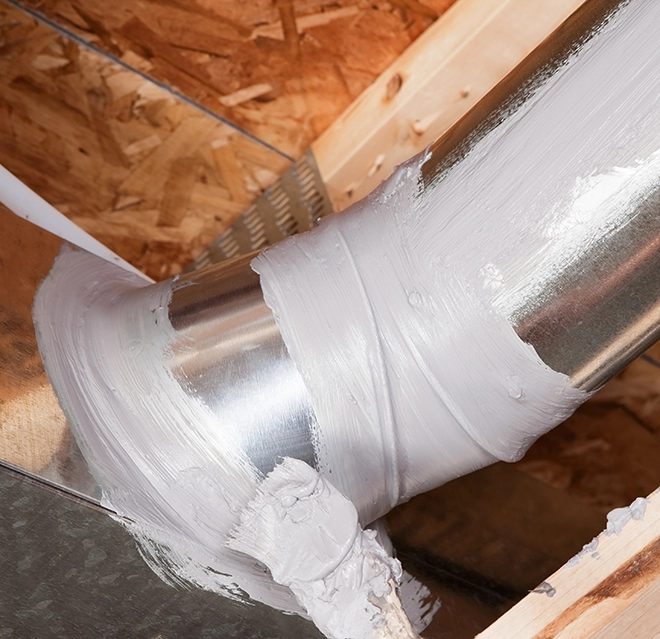
A picture of Air Duct sealing.

Measured, Not Guessed

Anyone can apply sealant and tell you it worked. The reason to test is that it converts an opinion into a number you can check.

Inspection comes first. Accessible runs in the attic, crawl space, or garage, looking for disconnected boots, separated connections at the plenum and takeoffs, crushed or kinked sections, sagging unsupported runs, damaged insulation, and dust streaking around joints, which is the visible fingerprint of air moving through a gap.

Static pressure is measured across the system. High static tells us the duct design or a restriction is choking the equipment, which is a different problem from leakage and needs a different fix. Both can be present at once.

Then a calibrated fan pressurizes the duct system and measures leakage in cubic feet per minute. That produces a baseline rather than an impression, and it localizes the problem, because a system with one large disconnection behaves very differently from one with fifty small gaps at takeoffs. The first gets a targeted repair. The second gets a systematic pass.

You get a prioritized plan, because not all leaks are worth the same effort, and the same measurement runs again afterward. Before number, after number, difference. We would rather hand you that than a description of work performed.

Mastic, Not Tape

The material matters far more than most homeowners are ever told.

Standard duct tape, despite the name, is one of the worst products available for sealing ducts. In an attic that reaches extreme summer temperatures, the adhesive degrades, dries, and releases. We routinely find tape applied years ago hanging off the joint it was supposed to seal.

Mastic is what the work requires. It goes on wet, cures flexible, tolerates the thermal cycling an attic delivers, and stays adhered for the life of the duct. It is messier to apply and it lasts.

Properly rated UL 181 foil tape has legitimate uses, particularly on rigid metal joints and as a mechanical assist under mastic. It is not a substitute for mastic on flex connections. And no sealant substitutes for a mechanical draw band actually holding a flex joint together, because sealant is not a structural connection.

One location gets skipped almost universally: the air handler cabinet itself. Seams, penetrations for refrigerant lines and wiring, and an access panel that may have no gasket at all. On an attic-mounted air handler every one of those openings faces the same hot humid air as the ducts, and the cabinet is frequently the single largest leak in the system.

Where we seal: every duct connection and joint, boot connections at the registers, the plenum connections at the air handler, penetrations through the cabinet itself, and access panels with proper gasketing. If a quote does not mention the air handler cabinet, ask about it, because it is frequently the largest single leak in the system and the one most often left alone.

What Duct Leakage Actually Costs You

Air you paid for, delivered to your attic. Supply-side leaks push conditioned air into unconditioned space. That portion of your utility bill buys nothing.

Attic air pulled into your house. Return-side leaks and pressure imbalance draw replacement air from wherever the system can find it. In a Gulf Coast attic in July that air is hot, extremely humid, and carries insulation fiber and dust.

Humidity you cannot get rid of. This is the connection most homeowners miss. If your system is importing humid attic air continuously, your air conditioner is fighting a moisture load you keep adding. People buy dehumidifiers to solve problems that are actually duct leaks. We would rather seal the leak. See whole-home dehumidification for the cases where you genuinely need both.

Rooms that never balance. Air escaping before it reaches the far bedroom is air that bedroom never gets.

Longer runtime and more wear. A system that has to run longer to reach setpoint accumulates hours, and hours are what equipment life is measured in.

Dust that comes back. Cleaning your ducts while the system continues to import attic air is a service you will buy repeatedly.

What Duct Leakage Actually Costs You
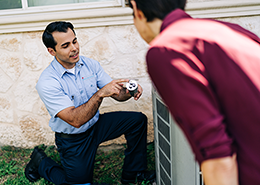
ASV technician arriving for repairs.

We Measure Before and After

Anyone can apply sealant and tell you it worked. The reason to test is that it converts an opinion into a number.

Inspection first. Accessible runs in the attic, crawl space, or garage. We are looking for disconnected boots, separated connections at the plenum and takeoffs, crushed or kinked sections, sagging unsupported runs, damaged insulation, and visible dust patterns around joints, which are the fingerprint of a leak.

Static pressure. Measured across the system. High static pressure tells us the duct design or a restriction is choking the equipment, which is a different problem from leakage and requires a different fix. Both can be present.

Duct leakage testing. A calibrated fan pressurizes the duct system and measures leakage in cubic feet per minute. That gives a baseline number rather than an impression. It also localizes the problem, since a system with one large disconnection behaves differently from one with fifty small gaps.

A prioritized plan. Not all leaks are worth the same effort. Disconnected boots and large openings at the plenum come first because they are most of the loss. Minor gaps at individual takeoffs matter in aggregate but they are not where the first dollar goes. You get the list in order of impact.

Post-seal retest. The same measurement, after. You see the before number, the after number, and the difference.

Mastic, Not Tape

The material matters more than most homeowners are ever told.

Duct tape fails. Standard duct tape, despite the name, is one of the worst products for sealing ducts. In an attic that reaches extreme summer temperatures, the adhesive degrades, dries, and releases. Tape applied five years ago is frequently found hanging off the joint it was supposed to seal.

Mastic works. A fiber-reinforced mastic sealant is applied wet, cures flexible, tolerates the thermal cycling an attic puts it through, and stays adhered for the life of the duct. It is messier to apply and it lasts.

UL 181 foil tape has a role. Properly rated foil tape is legitimate for specific applications, particularly on rigid metal joints and as a mechanical assist under mastic. It is not a substitute for mastic on flex connections.

Mechanical fastening first. A flex duct connection should be mechanically secured with a draw band before anything is sealed. Sealant is not a structural connection, and a joint held together only by mastic will fail.

Where we seal: every duct connection and joint, boot connections at the registers, the plenum connections at the air handler, penetrations through the air handler cabinet itself, and access panels with proper gasketing. The air handler cabinet is frequently the single largest leak in the system and it is routinely ignored.

Sealing, or Something Else

Sealing is the right fix for gaps, separations, and poor connections in ducts that are otherwise sound. It is not the fix for everything, and we will tell you which situation you are in.

Seal it when the ducts are physically intact, correctly sized, and adequately insulated, and the problem is leakage at joints and connections.

Repair or replace it when runs are crushed, torn, disconnected, undersized for the load, or when the flex duct has degraded past its service life. Sealing a collapsed duct accomplishes nothing. See duct repair and replacement.

Insulate it when the ducts are sealed but sweating, or when insulation has degraded or was never adequate. That is a condensation problem, not a leakage problem. See duct insulation.

Clean it when there is contamination inside. Different service, different purpose. See duct cleaning.

Most jobs involve more than one of these. Quoting them separately is how you can see what each one costs and decide.

New Construction Homeowners, Read This

If your home was built in the last several years and you are still inside your builder coverage, get the duct system evaluated now rather than later.

Rapid subdivision construction produces predictable duct defects: runs disconnected at the takeoff, crushed sections where something was set on them, sagging unsupported runs, undersized returns, and unsealed plenum connections. Homes settle over the first few years, which separates connections that were adequate at completion.

While your builder coverage is live, a duct defect is the builder's problem. After it expires, it is yours. We have found single disconnected runs that explained three years of complaints about one bedroom.

This applies particularly to the growth corridors in Beulah, Pace, and Navarre.

What Sealing Will and Will Not Do

It will reduce the conditioned air you lose, cut the humid attic air being pulled in, improve delivery to far rooms, reduce runtime, and reduce the rate at which your ducts recontaminate.

It will not fix an oversized system that short cycles, resolve an undersized return, repair physically damaged ductwork, or eliminate the need for dehumidification in a very tightly built home where the moisture load is generated indoors.

We will not quote you a specific percentage saving before testing. The honest answer depends entirely on how leaky your system is right now, and a company that promises you a number before measuring is guessing at your house.

Related Services

Written by the team at Aire Serv of Northwest Florida.
Technically reviewed by Justin B., NATE-certified and EPA 608 certified, 19 years in the trade.
Reviewed for accuracy by owner Justin Sonntag, a 26-year Gulf Coast resident.
Florida Certified Air Conditioning Contractor, license CAC1823566.

Last reviewed: August 2026

Questions about your system? Call or book online in about a minute.

The Aire Serv Advantage

From tune-ups and maintenance to heater repair and air conditioning replacement, we provide services that keep the air you breathe clean and keep your home or business at the perfect temperature.

Worry-Free HVAC Starts with Our Advantage Plan

Keep your system running smoothly with expert care you can count on.

Duct Sealing Questions

  • The symptoms are recognizable. One room that never reaches the same temperature as the rest. A house that feels humid even when the thermostat reads comfortable. Dust that returns quickly after cleaning. A system that runs noticeably longer than it used to. Visible dust streaking around duct joints in the attic, which is the fingerprint of air moving through a gap. But symptoms only suggest it. The way to know is a leakage test, which pressurizes the system with a calibrated fan and reports the loss in cubic feet per minute rather than as an impression.

Worry-Free HVAC Starts with Our Advantage Plan

Keep your system running smoothly with expert care you can count on.

Schedule Online

By checking this box, I agree to opt in to receive automated SMS and/or MMS messages from Aire Serv, a Neighborly company, and its franchisees to the provided mobile number(s). Messages & data rates may apply. Message frequency varies. View Terms and Privacy Policy. Reply STOP to opt out of future messages. Reply HELP for help.

By entering your email address, you agree to receive emails about services, updates or promotions, and you agree to the Terms and Privacy Policy. You may unsubscribe at any time.