What’s In This Article
- Why Does a Maintenance Schedule Matter for Commercial Buildings?
- What Belongs on Your Commercial Maintenance Checklist?
- Which Tasks Can Your Facility Team Handle?
- How Do New Refrigerant Rules Affect Your Maintenance Plan?
- How Do You Keep a Maintenance Program on Track?
- What Warning Signs Mean You Shouldn't Wait for the Next Scheduled Visit?
- Find Out More About Commercial HVAC Maintenance
- Schedule Commercial Maintenance With Your Local Aire Serv
- FAQs About Commercial Heating and Air Conditioning Maintenance
One of the best ways to reduce missed maintenance and catch developing equipment problems earlier is to use a written schedule that assigns a frequency and an owner to every task. Commercial heating and air conditioning systems benefit from routine checks throughout the year, especially before cooling season and before heating season, along with professional service based on equipment needs, operating conditions, manufacturer recommendations, and seasonal demands.
This checklist shows what to inspect, how often, and which tasks a trained service professional should handle. Whether you manage one retail suite or a portfolio of office buildings, use it as a starting framework and adjust it to your equipment, occupancy, manufacturer recommendations, operating conditions, and climate.
Why Does a Maintenance Schedule Matter for Commercial Buildings?
Heating and cooling equipment in a commercial building works harder than a typical home system. It runs longer hours, serves more people, and often sits on a roof exposed to weather year-round. A failure can mean uncomfortable tenants, lost productivity, or a closed storefront.
Energy use matters, too. According to the U.S. Energy Information Administration's 2018 Commercial Buildings Energy Consumption Survey, space heating accounted for nearly one-third of end-use energy consumption in commercial buildings, and ventilation alone accounted for 10% or more. Dirty, out-of-calibration, or low-on-refrigerant equipment may have to work harder to keep up.
A documented schedule also helps you:
- Catch worn belts, weak capacitors, and clogged drains before they cause a shutdown.
- Plan repairs and replacements on your timeline instead of during a heat wave or cold snap.
- Keep records that support warranty claims, insurance requirements, and environmental rules.
ANSI/ASHRAE/ACCA Standard 180 sets minimum inspection and maintenance requirements for commercial building heating, ventilation, and air conditioning systems. Many facility teams use it as a reference point when building their own maintenance programs.
What Belongs on Your Commercial Maintenance Checklist?
Group tasks by frequency so nothing slips between visits. The table below gives a quick overview, followed by a detailed checklist for each interval.
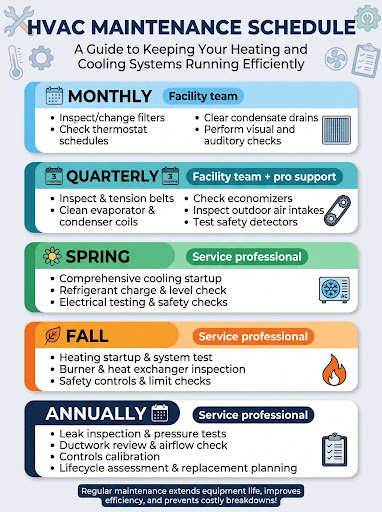
Monthly tasks
Quarterly tasks
Look at condenser and evaporator coils for dirt buildup that may restrict airflow.
Make sure economizer dampers open and close smoothly and aren't stuck.
Verify outdoor air intakes are clear of debris, nests, and stored materials.
Test smoke and carbon monoxide detectors in spaces with fuel-burning equipment.
Spring cooling startup
The following seasonal startup tasks generally require a trained service professional because they may involve refrigerant, electrical components, combustion equipment, or system-specific diagnostic procedures.
Check refrigerant charge and look for signs of leaks.
Test capacitors, contactors, and electrical connections.
Lubricate motors and bearings where applicable.
Confirm cooling performance and airflow across each zone.
Fall heating startup
Test burners, ignition systems, flame sensors, and gas pressure.
Check flues and venting for blockages.
Test safety controls and limit switches.
Verify heat pump defrost operation and backup heat, if applicable.
Annual tasks
Inspect accessible ductwork for leaks, damage, and loose connections.
Calibrate thermostats, sensors, and building controls.
Review equipment age, repair history, and performance to plan future replacements.
If your building doesn't have a maintenance schedule yet, or its last professional visit was more than six months ago, start with a baseline inspection. Schedule commercial heating and air conditioning maintenance with your local Aire Serv® service professionals to get a clear picture of every unit on your property.
Which Tasks Can Your Facility Team Handle?
A well-trained in-house team can handle much of the routine care. Some work, though, carries safety, warranty, or compliance risks, so professional service is the safer choice.
Your facility staff can likely handle tasks like changing filters and checking thermostat settings. However, leave any work involving refrigerant (which requires EPA certification), gas and electrical work, and diagnosing recurring complaints to the pros.
Incorrect repairs can turn a small issue into a bigger, more expensive one. Following manufacturer-recommended maintenance and keeping service records may also help support warranty documentation. When in doubt, flag the issue and let a trained professional take a look.
How Do New Refrigerant Rules Affect Your Maintenance Plan?
Refrigerant compliance is one of the most overlooked parts of commercial maintenance. Under the EPA's Emissions Reduction and Reclamation program, owners and operators of many appliances with 15 pounds or more of HFC-containing refrigerant must follow leak repair requirements starting January 1, 2026. For comfort cooling equipment, the leak rate threshold is 10%.
Residential and light commercial air conditioning and heat pump equipment is exempt from these leak repair requirements, so whether they apply depends on your equipment type and charge size. Larger systems serving office buildings, retail centers, and multifamily properties may fall within scope.
To build compliance into your checklist:
- Keep an up-to-date inventory of equipment, refrigerant type, and full refrigerant charge.
- Ask your service professional to document refrigerant added at every visit.
- Track leak rates and repair timelines for covered equipment.
- Store service records where your team can find them during an audit or ownership change.
Requirements can change, so confirm current requirements with EPA guidance and a qualified service professional.
How Do You Keep a Maintenance Program on Track?
A checklist only works when someone owns it. These habits help keep commercial maintenance consistent across seasons, staff changes, and multiple properties.
- Build an equipment inventory. Record each unit's location, age, model, serial number, filter size, and refrigerant type.
- Use one central log. A spreadsheet or computerized maintenance management system (CMMS) keeps service history in one place.
- Inspect after severe weather. Hail, high winds, and heavy snow can damage rooftop units between scheduled visits.
- Watch the complaint log. Repeated hot or cold calls from one zone often point to a damper, sensor, or airflow issue.
- Plan replacements early. Tracking repair frequency helps you budget for aging equipment before it fails.
- Coordinate with tenants. Share service dates in advance so visits cause as little disruption as possible.
One pattern worth watching: filters changed on a fixed calendar in a space that's been renovated, re-tenanted, or sits near active construction. Dust loads shift when a space is used differently, so check filters more often for the first few months after any change. Commercial air duct cleaning may also be worth considering after major renovation work.
What Warning Signs Mean You Shouldn't Wait for the Next Scheduled Visit?
Some problems can't wait for the next scheduled service. Call for a professional inspection if you notice:
- Rooms or zones that won't reach their set temperature.
- Equipment that turns on and off frequently (short cycling).
- Burning, musty, or unusual odors near equipment or vents.
- Water pooling around indoor units or leaking through ceiling tiles.
- Ice on refrigerant lines or coils.
- A sudden jump in energy use without a change in occupancy or weather.
If you smell gas, leave the area and contact your gas utility or emergency services first. For other urgent issues, Aire Serv offers 24/7 customer service with live answer and prioritizes urgent requests. Find your local Aire Serv to save their number before you need it.
Find Out More About Commercial Heating and Air Conditioning Maintenance
- Understand your options: See how Aire Serv supports heating and cooling for property managers across multiple buildings and tenant spaces.
- Prevent and maintain: Explore commercial air filter installation and replacement to support your monthly filter routine.
- Learn more: Review commercial indoor air quality solutions customized to your building's layout and use.
Schedule Commercial Maintenance With Your Local Aire Serv
A checklist keeps your team organized, but your equipment still needs a trained eye. Your local Aire Serv service professionals can perform commercial tune-ups and maintenance, inspect key components, and document their findings so you have a clear record for every unit.
Here's what you can expect:
- Guaranteed upfront pricing (charged by the job, not the hour) with no hidden fees.
- Highly trained, background-checked service professionals.
- Clear explanations in plain language before any work begins.
- Respect for your property and professional cleanup after every visit.
- Local ownership backed by a national network that has been in business since 1992.
Every job is backed by the Neighborly Done Right Promise®, which ensures we'll get the job done right.
Ready to get started? Request an appointment with your local Aire Serv professional today.
FAQs About Commercial Heating and Air Conditioning Maintenance
As an industry leader and a brand that is trusted by homeowners and businesses nationwide for our knowledge and experience, we're happy to answer your HVAC questions. Here are answers to some of the frequently asked questions about commercial heating and air conditioning maintenance.
How do warranties work on commercial heating and cooling units?
Standard commercial warranties vary by manufacturer, equipment type, and coverage plan. They often cover specified replacement parts, while labor coverage may be limited or offered separately.
Manufacturers usually require proof of routine service by certified professionals to maintain warranty eligibility and before approving claims. Property managers should review their warranty terms and keep service records to help support future claims.
Why are some office rooms always too hot while others are too cold?
Buildings naturally heat unevenly because of sun exposure and windows. Equipment heat, blocked vents, poor airflow, or improperly adjusted heating and air controls also add to uneven office temperatures. An HVAC professional can identify the cause and recommend solutions, such as airflow balancing, thermostat adjustments, or zoning improvements. The right approach depends on your building's layout and the existing heating and cooling system, and will depend on thermostat placement and if the existing setup has motorized dampers in the ducts.
How does regular maintenance help managers plan long-term building budgets?
Regular maintenance can help property managers anticipate expenses, identify developing equipment problems, and reduce the risk of unexpected repair bills.
Service reports give property managers advance notice of which older units are starting to wear out and show declining performance, making it easier to budget for planned replacements. While unexpected breakdowns can still occur, preventive maintenance can reduce the risk of costly disruptions.
Can preventive maintenance help reduce energy use?
Yes. Regular maintenance may help improve system efficiency by keeping coils clean, filters clean, airflow unrestricted, and controls calibrated. These tasks help heating and cooling equipment operate efficiently and may prevent unnecessary energy use. Results vary by building and equipment condition, and maintenance history, but a well-maintained system typically doesn't have to work as hard to meet demand.
AI Disclosure: This article may contain content, images, and/or multimedia generated with the assistance of artificial intelligence (AI). While we make every effort to review, edit, and ensure accuracy, completeness, and alignment with our content standards, we also encourage readers to verify facts, consult trusted professionals, and use their own judgment when making decisions based on their specific situation.
This article is intended for general informational purposes only and may not be applicable to every situation. You are responsible for determining the proper course of action for your home and property. Aire Serv is not responsible for any damages that occur as a result of this blog content or your actions. For the most accurate guidance, contact the Aire Serv location nearest you for a comprehensive, on-site assessment.