What’s In This Article
- Is Cold Air From Your Furnace Ever Normal?
- When Does the Cold Air Happen? Use the Timing to Narrow the Cause
- 7 Common Reasons Your Furnace Is Blowing Cold Air
- What Can You Safely Check Before Calling for Service?
- When Should You Stop and Call a Professional?
- How Can You Help Prevent Your Furnace From Blowing Cold Air?
- Discover More About Maintaining Your Furnace
- Get Warm Air Flowing Again With Aire Serv
- FAQs About a Furnace Blowing Cold Air
When a furnace blows cold air, the cause is often simple: the thermostat fan is set to ON, or a clogged filter is making the furnace overheat and shut off its burners. Other times, the furnace can’t light or sense its flame, or warm air is escaping through leaky ducts before it reaches you. A few quick checks can rule out the easy fixes, and the timing of the cold air can tell you a lot about what’s wrong.
If you can’t troubleshoot or identify the cause of cold air from your furnace, contact a service professional right away. Waiting can turn a small issue into a bigger problem and leave you in the cold longer than necessary.
Is Cold Air From Your Furnace Ever Normal?
Sometimes, yes. It helps to know how a healthy gas furnace runs through a heating cycle.
- At startup: The burners light first, then the blower waits briefly while the heat exchanger warms up. Air that has been sitting in the ducts may feel cool for a moment when the blower starts.
- At the end of a cycle: After the thermostat is at the set temperature, the burners shut off, but the blower keeps running to pull leftover heat out of the furnace. That air gets cooler as the cycle winds down.
- With the fan set to ON: The blower runs nonstop, even between heating cycles. Air moving through ducts in a cold attic or crawlspace can feel chilly when the burners aren’t firing.
If you feel cool air at the start or end of a cycle, your furnace is likely doing its job. If the air stays cold the entire time the blower runs, or the house never reaches the set temperature, it’s time to take a closer look.
When Does the Cold Air Happen? Use the Timing to Narrow the Cause
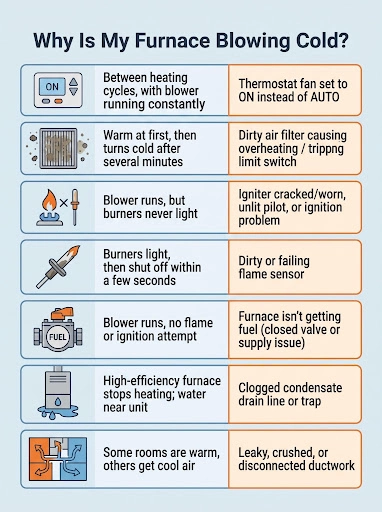
Service professionals often ask about timing first, because it quickly separates airflow problems from ignition and fuel problems.
7 Common Reasons Your Furnace Is Blowing Cold Air
1. The thermostat fan is set to ON
This is a common cause and one of the easiest checks. Set the thermostat to HEAT and the fan to AUTO so the blower runs only when the burners heat. While you’re there, confirm the set temperature is above the room temperature and replace the thermostat batteries if the display is dim or blank.
2. A clogged air filter is causing the furnace to overheat
A dirty filter restricts airflow, so heat builds up inside the furnace. When it gets too hot, a safety device called the high-limit switch shuts off the burners while the blower keeps running to cool things down. You feel warm air, then cool air, then the cycle repeats. Over time, repeated overheating can put stress on the heat exchanger.
ENERGY STAR®, administered by the U.S. Environmental Protection Agency, recommends checking your filter monthly during heavy-use seasons and changing it at least every three months.
3. The pilot light or igniter isn’t lighting the burners
Newer furnaces use an electronic igniter, while older models may have a standing pilot light. If the igniter is cracked or worn, or the pilot has gone out, the blower can run without delivering heat. If you have an older furnace with a pilot, relight it only by following the instructions on the furnace label.
4. A dirty flame sensor is shutting off the burners
The flame sensor is a thin metal rod that confirms the burners are lit. When it gets coated with residue, it can’t detect the flame, so the furnace shuts off the gas quickly as a safety measure. The blower may keep running without heating the air.
Cleaning or replacing the sensor is a common repair, but it requires shutting off power and gas and removing internal parts, so a trained service professional should handle it.
5. The furnace isn’t getting fuel
If you bumped the gas valve near the furnace closed, or if your gas service is interrupted, the burners can’t light. You may visually check to see if the valve appears to be closed, but do not touch it if you smell gas or are unsure. Confirm whether other gas appliances, such as a range, are working. For propane systems, check the tank level.
6. A clogged condensate line is stopping a high-efficiency furnace
High-efficiency condensing furnaces, often recognizable by white plastic vent pipes, produce water as they run. If the drain line or trap clogs with debris or algae, a pressure switch or float switch can stop the burners to prevent water damage. Look for water around the base of the furnace or a full condensate pump.
7. Leaky or disconnected ducts are losing warm air
Sometimes the furnace produces heat, but it doesn’t reach your rooms. According to ENERGY STAR, about 20–30% of the air moving through a typical home’s duct system is lost to leaks, holes, and poorly connected ducts. If some rooms get cooler air than others, ductwork is a likely suspect.
If you’ve checked the thermostat and filter and the air is still cold, the next steps usually involve ignition parts, gas controls, or ductwork. That’s where Aire Serv® furnace repair services can help. Your local service professional can find the cause and explain your options in clear, everyday terms.
What Can You Safely Check Before Calling for Service?
These quick checks take a few minutes and don’t require tools:
If the furnace shuts off again after a reset, don't reset it repeatedly. Repeated lockouts usually signal an underlying problem.
When Should You Stop and Call a Professional?
Some signs mean it’s time to step back and let a trained professional take over. Leave the home right away and call your gas utility or 911 from outside if you smell rotten eggs or your carbon monoxide alarm sounds. The CDC notes that carbon monoxide is odorless and colorless and can cause sudden illness or death, which is why working carbon monoxide detectors are essential.
Schedule service if you notice any of these:
- Burners that won’t light or shut off quickly
- Cold air that continues after you’ve replaced the filter
- A burning, electrical, or musty smell from the vents
- Soot, scorch marks, or a yellow, flickering burner flame
- Water pooling around the furnace
- Frequent short cycling or repeated error codes
Furnace repairs involve gas, high-voltage electricity, and safety controls. An incorrect repair can lead to bigger problems and may affect your warranty, while a service professional can test gas pressure and confirm safe venting.
Your local Aire Serv offers 24/7 customer service with a live answer, and we prioritize urgent requests. Find your local Aire Serv to get help when the heat isn’t keeping up.
How Can You Help Prevent Your Furnace From Blowing Cold Air?
Most of these problems develop slowly, so regular care can often catch them early.
- Schedule an annual furnace tune-up in early fall. A furnace tune-up includes cleaning and inspecting key parts, such as the flame sensor, igniter, and burners, before you need heat.
- Check the filter monthly during winter. Homes with pets or ongoing remodeling may need more frequent changes. Our team also handles air filter replacement.
- Have your ducts inspected. Sealing leaks and reconnecting loose sections may help improve system efficiency and room-to-room temperature balance. Learn about our air duct services.
- Test your carbon monoxide detectors. We offercarbon monoxide detector installation for added peace of mind.
If your furnace is older and needs frequent repairs, your service professional can walk you through furnace replacement options without pressure. Each Aire Serv location is independently owned and operated, so check with your local service professionals to verify which services they provide.
Discover More About Maintaining Your Furnace
- Learn more: How often should a furnace cycle in winter?
- Diagnose: Why does my furnace keep tripping the reset button?
- Prevent and maintain: Heating and air conditioning tune-ups and maintenance
Get Warm Air Flowing Again With Aire Serv
When your furnace won’t deliver steady heat, your local Aire Serv is ready to help. Aire Serv has been in business since 1992, and every location is locally owned and operated with the support of a national network. Our highly trained, background-checked service professionals explain what they find in plain language, respect your home, and clean up before they leave.
- Upfront pricing, charged by the job rather than the hour, with no hidden fees
- Total Comfort Checklist, a system health check included with every visit
- Aire Serv Advantage Plan® membership options with annual tune-ups, priority service, and member discounts
Every job is backed by the Neighborly Done Right Promise®, which ensures you’ll be happy with our work. Schedule service with your local Aire Serv today.
FAQs About a Furnace Blowing Cold Air
30+ years in the HVAC business have taught us a lot, including the importance of sharing our knowledge and experience to answer your questions about HVAC service. Here are answers to some of the frequently asked questions about furnaces blowing cold air.
Why is my furnace still blowing cold air after I changed the filter?
If the filter was very dirty, the furnace may have already locked out after overheating. After replacing the filter, follow the furnace manufacturer’s instructions for restarting the system. You’ll likely turn the thermostat off, then back to HEAT. If the furnace shuts down again or continues blowing cold air, don’t keep resetting it. The cause is likely ignition, the flame sensor, or the gas supply, which calls for professional service.
Is a furnace blowing cold air an emergency?
It’s usually not dangerous on its own, but it can become urgent in freezing weather and when pipes or vulnerable household members are at risk. It’s an emergency if you smell gas or your carbon monoxide alarm sounds. Leave the home and call for help from outside.
How long should it take for warm air to come out of the vents?
Gas furnaces typically need a short delay between the burners lighting and warm air blowing. If the air is still cool after steady blower operation, something is likely interfering with heating.
Why does my heat pump blow cooler air than a furnace?
Heat pump air is warm but not as hot as furnace air, so it can feel cool to the touch. Defrost mode can also blow cooler air. If it never warms your home, schedule heat pump service.
How often should I have my furnace serviced?
Plan on professional maintenance once a year, ideally in early fall. ENERGY STAR recommends seasonal checkups to catch problems before the heating season, and an Aire Serv Advantage Plan makes it easy to stay on schedule.
AI Disclosure: This article may contain content, images, and/or multimedia generated with the assistance of artificial intelligence (AI). While we make every effort to review, edit, and ensure accuracy, completeness, and alignment with our content standards, we also encourage readers to verify facts, consult trusted professionals, and use their own judgment when making decisions based on their specific situation.
This article is intended for general informational purposes only and may not be applicable to every situation. You are responsible for determining the proper course of action for your home and property. Aire Serv is not responsible for any damages that occur as a result of this blog content or your actions. For the most accurate guidance, contact the Aire Serv location nearest you for a comprehensive, on-site assessment.